You have decided to the expand to the U.S. market. The demand is real, your peers are already moving, and staying idle has a price of its own. So you look for help with your US market entry strategy and find that nearly everyone offers the same product: an engagement that ends in a report. A market study. A competitive landscape. A list of recommendations, a handshake, and an invoice. The document is now your problem to execute.
We have a different perspective. A report will not get you into the U.S. market, because the complexities that need to be considered on the ground will rarely appear in one. They are unknown unknowns. The buyer who was never going to sign. The price that diminished your credibility. The enthusiasm that turned out to be politeness.
Managing those risks takes more than analysis. It takes a system built from real market intelligence, a network that vouches for you, pricing and positioning that fit American buyers, and a partner who executes beside you rather than advising from a distance. Not a sales agent opening doors. We call this systems-based venture building. This article explains what it is, why it reduces risk, and how it keeps your spend behind your evidence.
What is systems-based venture building?
Systems-based venture building means your market entry partner co-executes expansion with you, contributing their network, market intelligence, positioning and pricing frameworks, and buyer strategy as working infrastructure instead of delivering recommendations and leaving. The end state is a system rather than a product: a repeatable commercial motion that keeps working after any single deal closes.
The contrast with market entry consulting is structural, and it shows up in four places.
- The deliverable. A consulting engagement ends when the report is delivered. A venture building engagement ends when the system works, meaning there is a validated buyer map, a defensible price, active partnerships, and a pipeline with real decision makers in it.
- The incentive. Advisory fees get paid whether or not you succeed. A co-execution model ties the partner’s outcome to yours, reduced fees coupled with compensation on delivery. Our own operating principle is simple: we don’t extract, we build, together.
- The asset you keep. A consulting engagement leaves you with a document. A venture building engagement leaves you with relationships, positioning, pricing logic, and a roadmap built to suit. Those assets compound.
- The rooms you can reach. Reports do not open doors. Networks do. A systems partner brings the triple helix into one working environment: government collaboration, academic validation, and private sector buyers and strategic partners. Credibility transfers through a warm introduction in a way cold outreach can never match.
None of this dismisses analysis. Analysis is an input to the system, not a substitute for it.
You don’t know what you don’t know
The case for a system over a study is simple. Studies answer the questions you already knew to ask, and U.S. market entries rarely fail on those. In our decades of experience guiding European companies into the U.S. market, four blind spots do the real damage, and none of them show up in a market report.
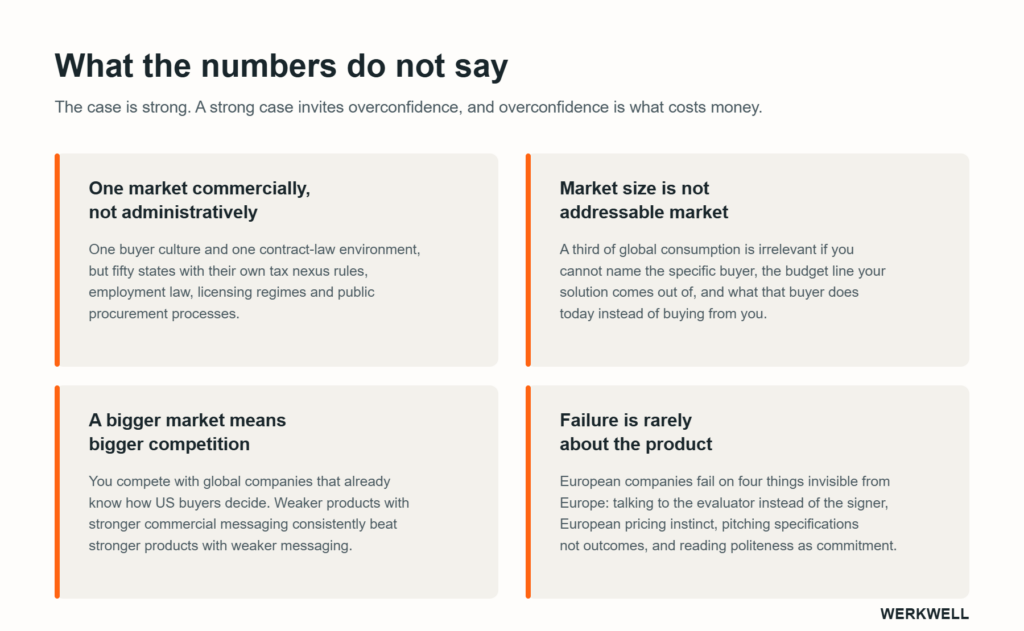
The wrong buyer. The person who evaluates is rarely the person who signs. One client spent seven months in productive, warm conversations with a counterpart who had no authority to write a check. Once the conversation moved to the actual decision maker, the deal closed. No market study flags this, because it is a property of how you navigate the market rather than a property of the market itself.
Enthusiasm read as commitment. American business culture runs on positivity. Every meeting feels promising and every introduction feels warm. Commitment looks different. It has a named decision maker, a budget line, and a date on a calendar. Founders who build pipeline on enthusiasm find out the difference, often after spending months or years and too much money learning the hard way.
Underpricing. European companies routinely price for approval, low enough that nobody objects. U.S. buyers read a low price as low confidence, and low confidence as risk. We advised one client to price to the value they delivered, in their case 20 to 40% energy savings, rather than the cost of delivery. They tripled the proposed fee, won the contract, and it became their most profitable project to date.
European speed in an American market. A proposal that takes six weeks to arrive tells a U.S. buyer everything they think they need to know. Over there, a two-week turnaround is the expectation, not a point of pride.
Each of these feels, from the inside, like doing things properly. Thorough. Modest. Precise. That is exactly what makes them unknown unknowns. Intelligence, in the market entry sense, is having someone in the room who has watched these patterns often enough to name them before they cost you a year or a client opportunity.
Want an obligation-free read on your own gaps? Fill out the WerkWell U.S. Readiness Assessment, a structured self-assessment across positioning, pricing, buyer strategy, team, and capital.
Enter with intelligence: the market pull is real
Intelligence starts with an accurate picture of demand, and the American demand picture is unusually clear right now. The investment needed to bring U.S. infrastructure to a state of good repair is USD 9.1 trillion from 2024 to 2033, compared with USD 5.4 trillion in projected funding. That leaves a USD 3.7 trillion gap at current spending levels. Six forces are widening it faster than domestic supply can close it: climate resilience, infrastructure modernization, digital transformation, AI-enabled asset management, labor shortages, and decarbonization. For European companies in energy efficiency, climate resilience, construction technology, and smart materials, this is documented, funded demand looking for credible suppliers.
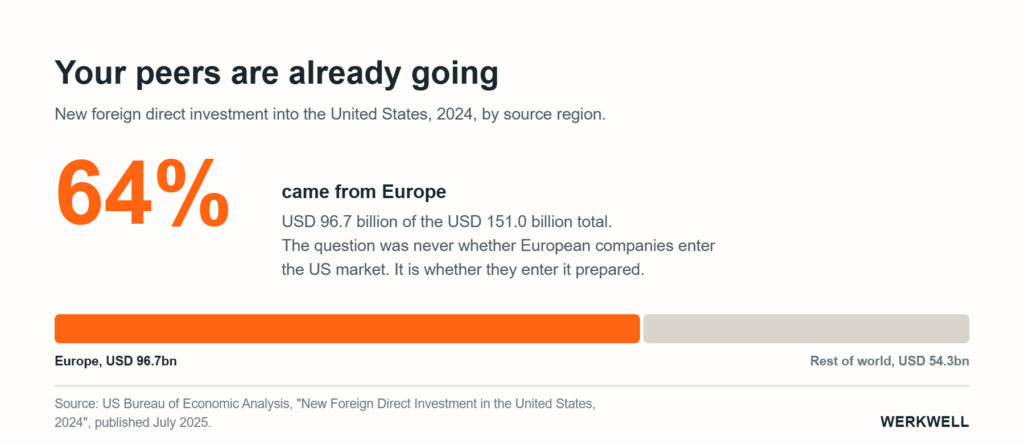
European companies are answering. Foreign investors spent USD 151.0 billion acquiring, establishing, or expanding U.S. businesses in 2024. Europe contributed USD 96.7 billion of it, 64% of all new investment, supporting 204,200 employees at those businesses. Among your peers, US expansion is the established move, not the exotic one.
Market pull is only half of intelligence, though. The other half is specific to you. Which segment buys first. Who inside those organizations evaluates, and who signs. What reference points they price against. Which two or three warm introductions collapse a year of door knocking into a quarter. That knowledge lives in networks and in pattern recognition, which is why it has to sit inside the system and not in an appendix to a report.
Reduce risk, streamline your spend: sequence before size
The cheapest risk reduction in market entry is doing things in the right order. In our experience the expensive failures follow a recognizable sequence. Entity first. Hires second. Campaigns third. Learning last. After six figures are already committed and the company discovers its positioning doesn’t land, its price signals weakness, or its target buyer was never the one who signs. The money wasn’t wasted because the market was wrong. It was wasted because the spending ran ahead of the knowing.
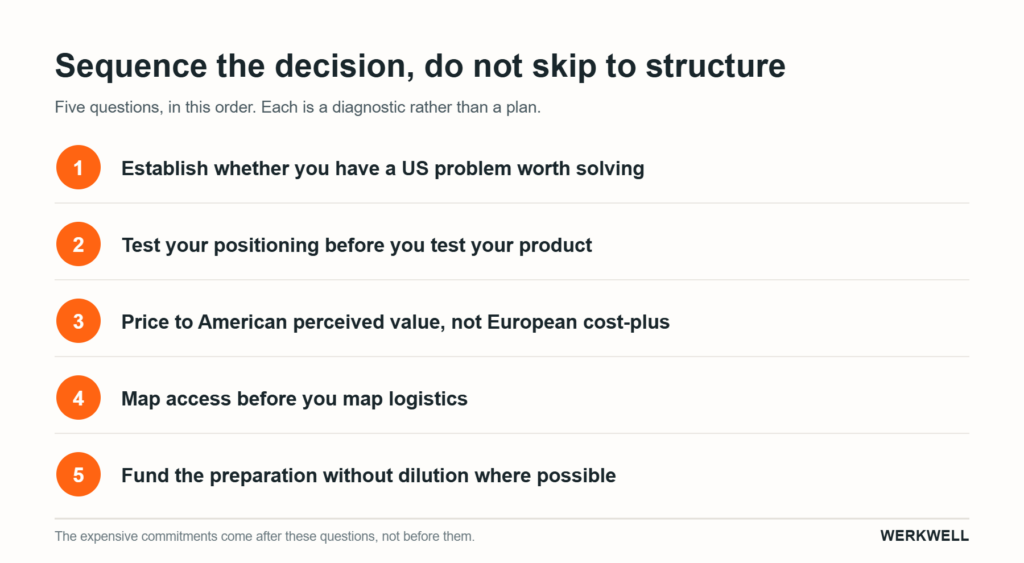
A systems-based go-to-market strategy inverts that order:
- Readiness gap analysis first. An honest, structured read on where you stand across the market, positioning, pricing, buyer strategy, team, and capital, before any irreversible commitment.
- Positioning and pricing built for the American buyer. Outcomes and credibility rather than specifications and modesty, with a price that says you believe your own value story.
- Buyer map and warm introduction strategy. Know who signs, and arrive through a relationship instead of a cold list.
- A 12-24 month roadmap you own. Sequenced commitments, each one gated by what the previous step proved.
- Entity, hires, and heavier investment when the system says go, with legal, tax, and structural questions handled by specialist partners at the point they genuinely arise.
Sequencing also changes what the entry costs. Structured preparation replaces a year of trial and error with a plan, and non-dilutive instruments can carry more of the load than most founders assume. Dutch companies, for example, may be able to reclaim a up to 70% of qualifying market preparation costs through the RVO Support International Business (SIB) scheme, subject to eligibility conditions and to applying before the activity takes place. Intelligence applies to the funding side too.
What co-execution looks like in a US market entry strategy
In practice, co-execution means the partner is measurably in the work: opening its network for warm introductions, sitting in the buyer conversations, defending the price beside you, and adjusting the roadmap as the market answers back. One client described a four-day roadshow of structured U.S. meetings we built around their venture as more progress than they had made in two years on their own. Four days of meetings are not magic. The right rooms, in the right order, with credibility handed over at each step, compress time in a way solo effort cannot.
The most direct way to experience the model is the WerkWell Executive Masterclass, one full day in person, built for European founders and executives planning US expansion within 3 to 24 months. It is a working session, not a lecture. You complete your own readiness gap analysis, build a pricing-to-value framework, map the U.S. buyer hierarchy for your segment, design a partnership and warm introduction strategy, and draft your 12-month market entry roadmap, with guest experts from the U.S. Embassy, RVO, and leading U.S. law firms. You walk out with a roadmap, not a report.
Frequently asked questions
What is systems-based venture building?
It is a market entry model in which the partner co-executes the expansion, contributing network, market access, market intelligence, positioning, pricing logic, and buyer strategy as working infrastructure rather than delivering recommendations and stepping away. The engagement ends with a functioning commercial system in the target market, not a document.
How is that different from hiring a market-entry consultant?
In three ways. The deliverable: a working commercial motion instead of a report. The incentive: shared success instead of fees regardless of outcome. The asset: relationships, positioning, and a roadmap instead of a study. Analysis still happens in a venture-building model. It feeds execution instead of replacing it.
How long does U.S. market entry take for a European company?
Plan in quarters, not weeks. A readiness-first sequence typically produces a validated roadmap within weeks and meaningful buyer traction within the first year. The companies that move fastest are usually the ones that resisted spending heavily before their positioning, pricing, and buyer map were proven.
What does U.S. market entry cost?
It depends on sequence more than ambition. Committing to entity setup, hires, and campaigns before validating your positioning routinely turns into a six-figure first-year lesson. A diagnostic-first sequence keeps early spend small and reversible, gates larger commitments on evidence, and can be partly offset by instruments such as the Dutch RVO subsidies for qualifying companies who apply in advance and meet the necessary conditions.
Do we need a U.S. legal entity before we start?
Usually later than founders assume. Entity, tax, and immigration questions are real, but they are execution details that should follow a validated commercial case rather than precede it. They also belong with specialist legal and tax advisors, which WerkWell is not. We focus on the commercial go-to-market layer and bring legal experts into the room at the right moment.
What is the WerkWell Executive Masterclass?
A one-day, in-person, executive-level working session where European founders build their own U.S. readiness gap analysis, pricing-to-value framework, buyer navigation map, and 12-month market entry roadmap, alongside guest experts. Dutch participants may be eligible for 50% reimbursement through the RVO SIB Export Training subsidy when they apply in advance.
The takeaway
The U.S. opportunity is quantified, funded, and already being claimed by your European peers. What separates the companies that convert it from the companies that spend a year learning expensive lessons is not a better report. It is a system: intelligence about how American buyers decide, a network that transfers credibility, a price that projects confidence, and a sequence that keeps spend behind evidence. You don’t know what you don’t know. The point of a systems-based partner is that someone in the room does. Build your US market entry strategy as a system rather than a study, and that knowledge is already in the room.
Ready to build the roadmap? Reserve your seat at the 2026 WerkWell Executive Masterclass.
WerkWell provides strategic, commercial go-to-market support. Nothing in this article constitutes legal, tax, or financial advice; consult qualified advisors for entity, tax, immigration, and subsidy decisions. RVO SIB eligibility, exclusions, and application requirements are determined by RVO.