
Most guides to US market entry for European companies start with entity structures and tax nexus. Those are downstream questions. The upstream one is the one that decides whether the investment is worth doing, and it has a clearer answer than most boards realize.
What US market entry for European companies actually means
US market entry for European companies is the decision to build a commercial position in the United States: customers, pipeline, credibility and often capital, rather than to fulfill the occasional American order from Europe.
That distinction matters more than it sounds. Plenty of European companies have US revenue. Far fewer have a US market position. The first is a series of transactions that arrive; the second is a system that produces them. Everything that makes American expansion expensive- the positioning work, the pricing recalibration, the relationships, the physical presence- is the cost of moving from the first state to the second.
Most published guidance skips this and goes straight to structure: which entity, which state, employer of record or subsidiary. Those questions are real, and they are also premature. They describe how to build a container before anyone has established what goes in it. The prior question, and the one the numbers below answer, is why US market entry for European companies is worth the cost and the risk at all.
The United States is the single largest commercial market in the world
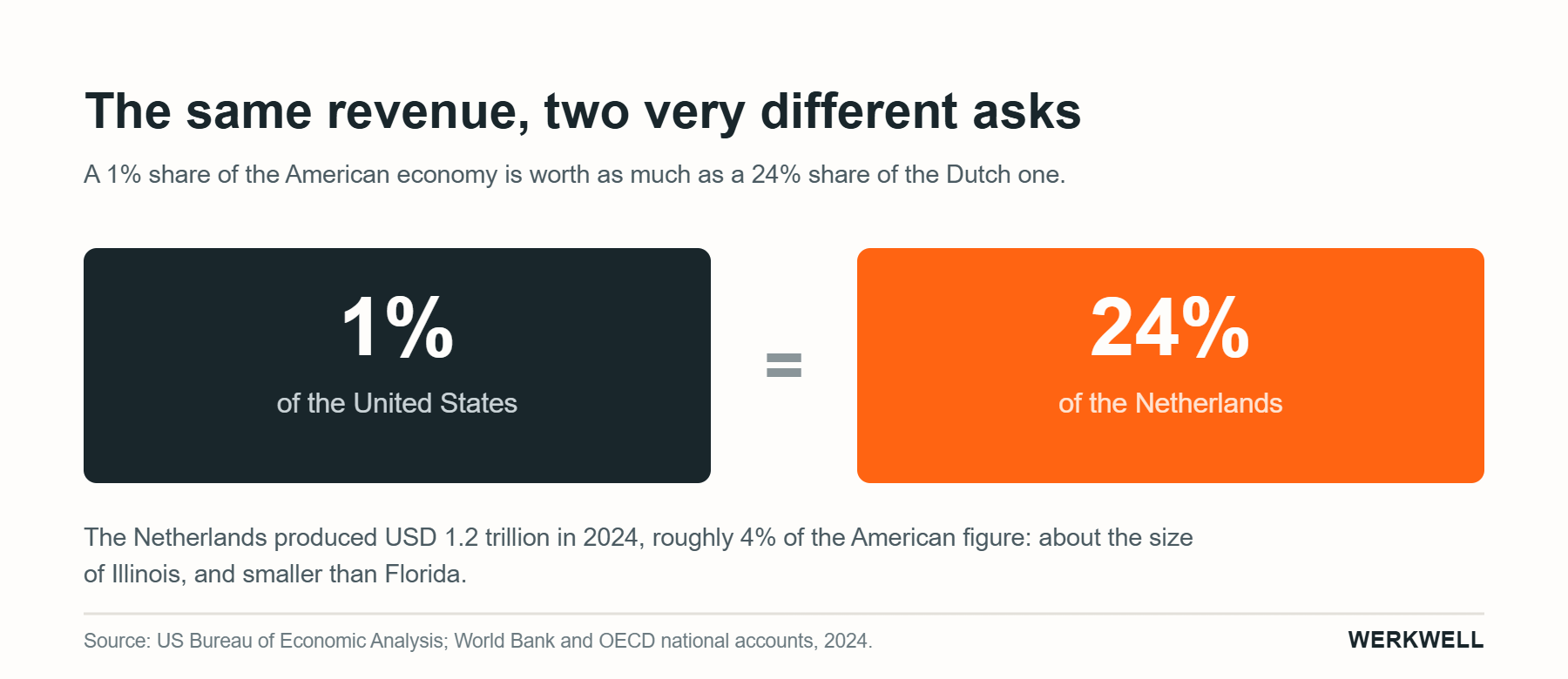
The Netherlands produced USD 1.2 trillion in 2024, about 4% of the American figure. The entire Dutch economy is roughly the size of Illinois, the fifth-largest state economy in the United States, and smaller than Florida, according to the US Bureau of Economic Analysis.
Stated in trillions, this is abstract. Stated as a consequence for one company, it is not: a 1% share of the American economy is worth as much as a 24% share of the Dutch one, and in 2024 alone the United States added USD 1.5 trillion of output in current dollars, more than the Netherlands produces in a year. For a European scale-up, the entire domestic market is a rounding error compared with the opportunity on the other side of the Atlantic, not because the Netherlands is a bad market, but because it simply isn’t big enough.
Scale alone is not the argument, though. Plenty of large markets are effectively several markets wearing trench coats. What makes the United States unusual is that roughly 340 million people operate under a single commercial logic: one language of business, one federal contract-law environment, one broadly shared set of buyer expectations across the country. A company that lands a customer in Massachusetts has, in commercial terms, learned most of what it needs to land one in California.
The EU constraint nobody prices in
Selling across an internal EU border still costs the equivalent of a 67% tariff on goods and 95% on services. In construction services specifically, the figure exceeds 120%, higher than almost any real tariff anywhere in the world.
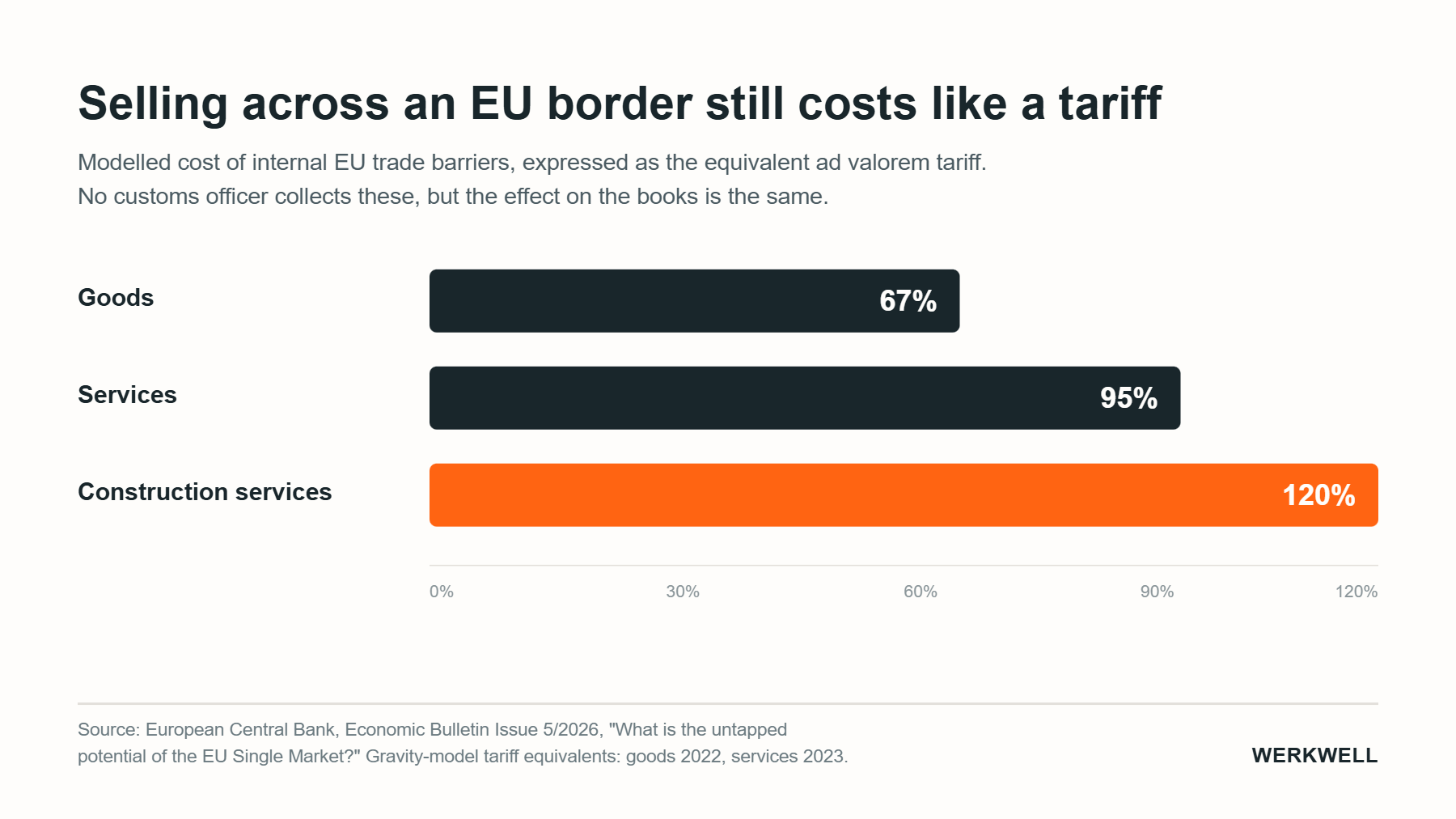
These are not literal tariffs. No customs officer collects them. They are the modeled cost of everything that still differs between member states: divergent technical standards, national certification and permitting regimes, professional qualification rules, language, and administrative overhead. The effect on a company’s books is like a tariff: it makes cross-border sales materially more expensive than domestic sales, which is why so many European companies remain national companies with export brochures.
The ECB’s own conclusion is that closing the identified gaps would raise intra-EU services trade by 14.5%. That is the scale of what fragmentation currently suppresses. It is also why the Single Market agenda exists and is being pushed hard at the European level.
None of which helps a company that needs to grow this year. European integration is a decade-scale project. A scale-up with a proven product and a five-year window cannot wait for it and should not build a growth plan that assumes it. Growth inside Europe means re-entering the market at every border. Growth in the United States means entering once, if properly prepared.
For companies in the built environment, this is the single most important number in this article.
A 120% internal cost on construction services means the European market for building systems, materials and infrastructure technology is among the most fragmented, and that the American alternative is not just larger, but structurally simpler to sell into.
The second constraint on US market entry for European companies: growth capital
Market access is only half of the problem. The other half is that Europe does not currently have the capital base to carry a company through scale-up once demand is found.
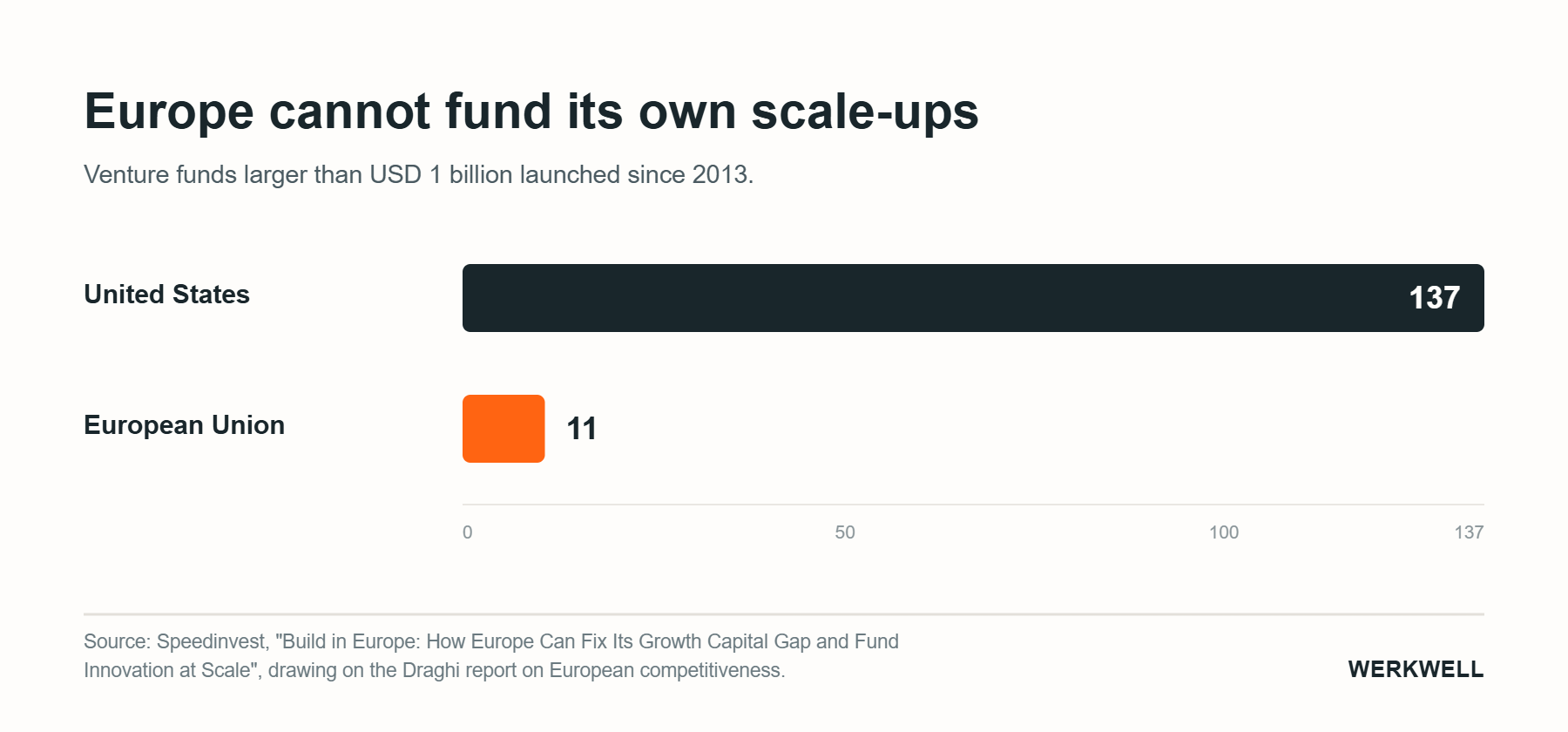
Since 2013 the United States has launched 137 venture funds larger than USD 1 billion. Across the European Union only 11 funds of this size have launched. European startups attract 54% less private funding nine years after founding than their American counterparts, and European pension funds allocate roughly 0.12% of their capital to venture and growth against roughly 3% in the US.
Close to 30% of European unicorns relocated their headquarters abroad between 2008 and 2021, predominantly to the United States. They left because the customers and the capital were in the same place, and because being a European company with American revenue is a materially different fundraising conversation from being a European company without it.
This makes US market entry for European companies a valuation question as well as a revenue one. Growth investors increasingly price European companies on their American traction. A credible US position changes the terms of the next round, sometimes more than the revenue itself does.
Your peers have already reached this conclusion about US market entry for European companies.
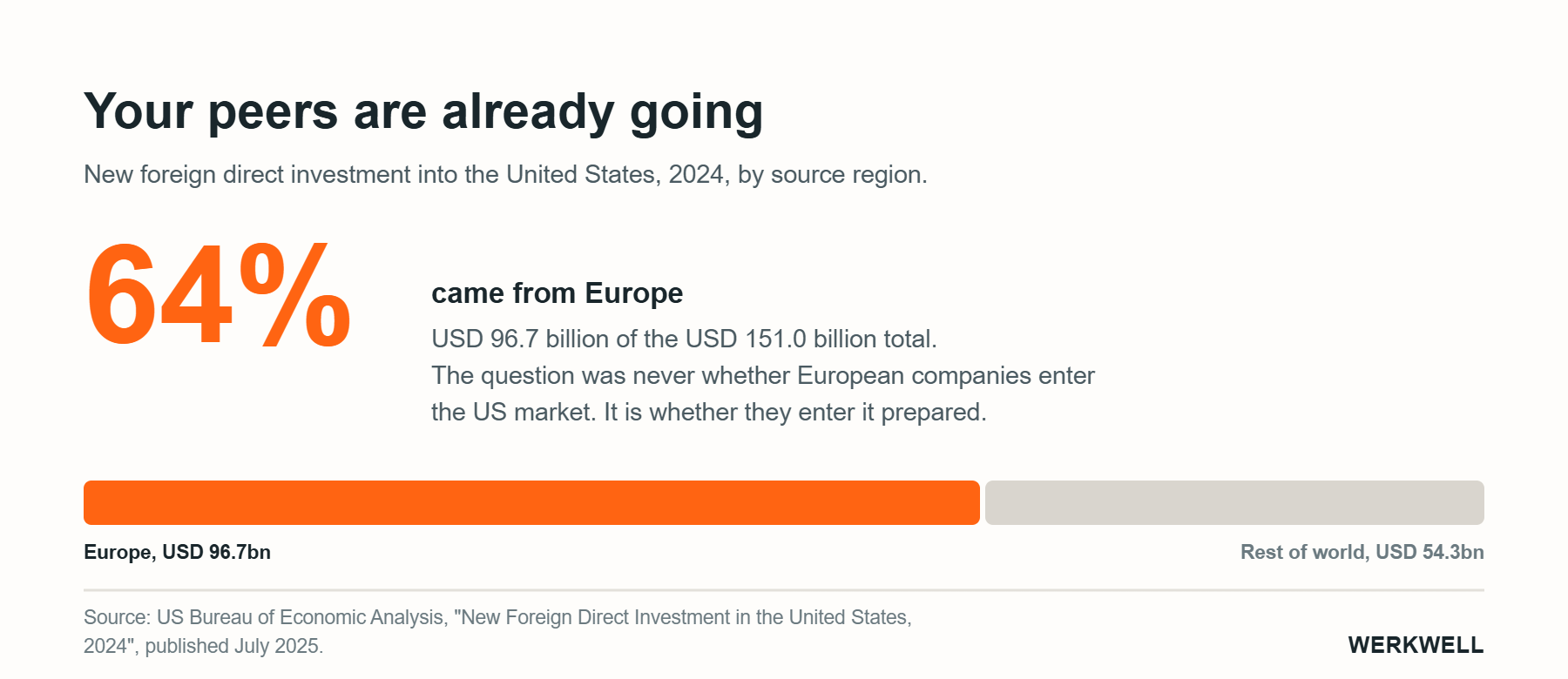
European companies are not, in aggregate, hesitating about America. They are going. The open question was never whether European businesses should enter the US market; it is whether they enter it prepared, and how much of that USD 96.7 billion was spent efficiently.
It is worth noting that total new FDI into the US fell 14.2% in 2024, from USD 176.0 billion the year before, and was well below the USD 277.2 billion decade average. Capital is being deployed more selectively than it was. That tightens the standard: an underprepared entrant competes for attention against better-prepared ones in a market where the money is being spent more carefully.
What these numbers do not say
The numbers above make a strong case for US market entry for European companies, and a strong case can invite overconfidence, which can be costly.
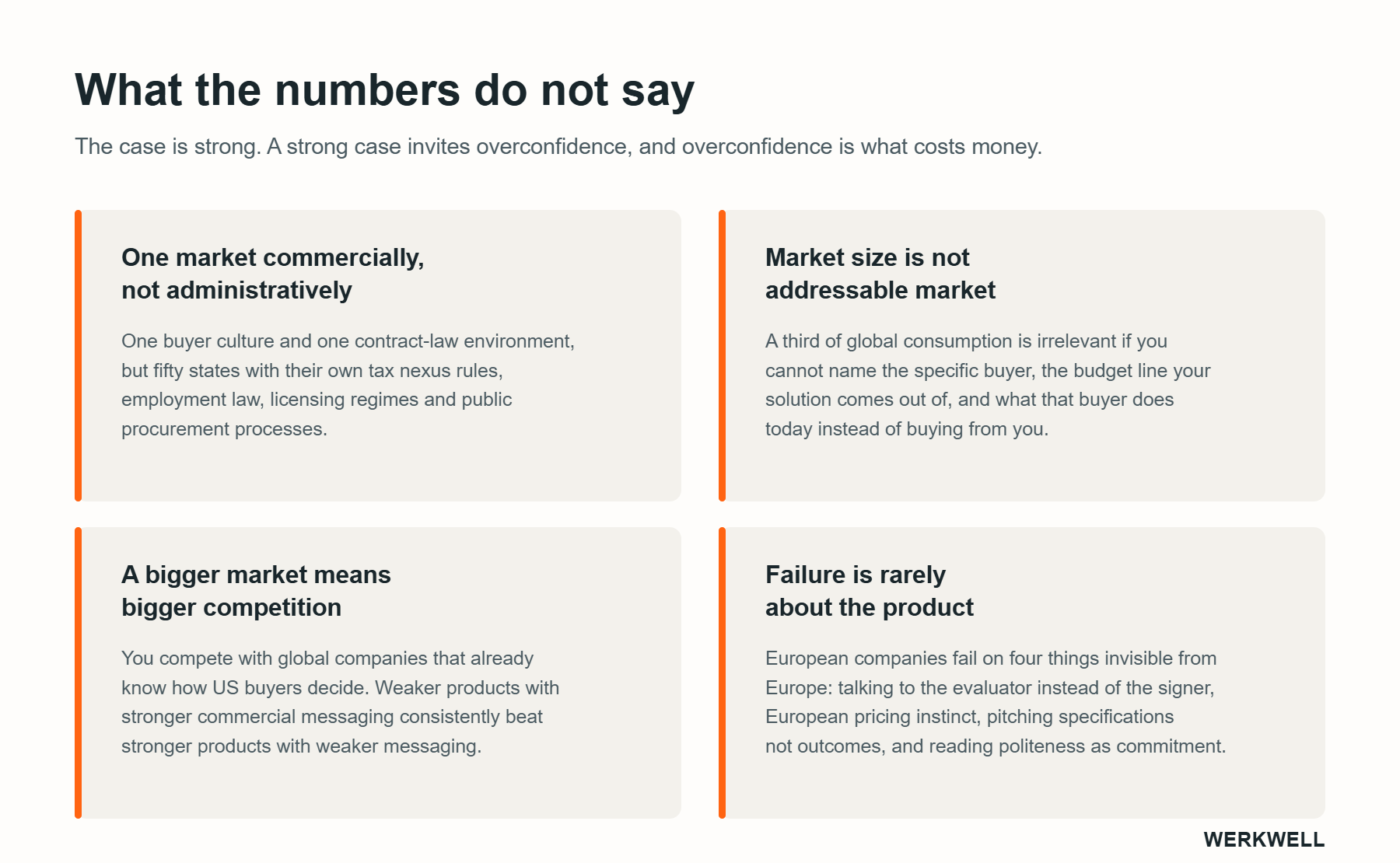
- The US is one market commercially, not administratively. One buyer culture and one contract-law environment, yes, but also fifty states with their own tax nexus rules, employment law, licensing regimes and public procurement processes. Anyone describing US entry as frictionless is selling you entity setup, not market success.
- Market size is not addressable market. A third of global consumption is irrelevant if you cannot name the specific buyer, the budget line your solution comes out of, and what that buyer does today instead of buying from you.
- A bigger market means bigger competition. You will not only be competing with American incumbents. You will be competing with global companies that have already learned how US buyers make decisions, and technically weaker products with stronger commercial messaging consistently beat stronger products with weaker messaging.
- European companies rarely fail in America on product. In our experience, they fail on four things that are invisible from Europe: talking to a technical evaluator instead of the person who signs; pricing to European instinct instead of American perceived value; pitching specifications when the buyer is purchasing an outcome; and reading American enthusiasm as commitment when it is politeness. None of these are intelligence failures. They are information problems.
This is the real conclusion: US market entry for European companies almost never fails on the numbers. The risk is entirely in the execution, and the expensive mistakes cluster in the first twelve months, before anyone has learned enough to know they are making them.
How to sequence US market entry for European companies
US market entry for European companies is a sequencing problem before it is a structuring one. Five questions, in this order. Each is a diagnostic rather than a plan; the point is to establish what you know and make visible what you don’t.
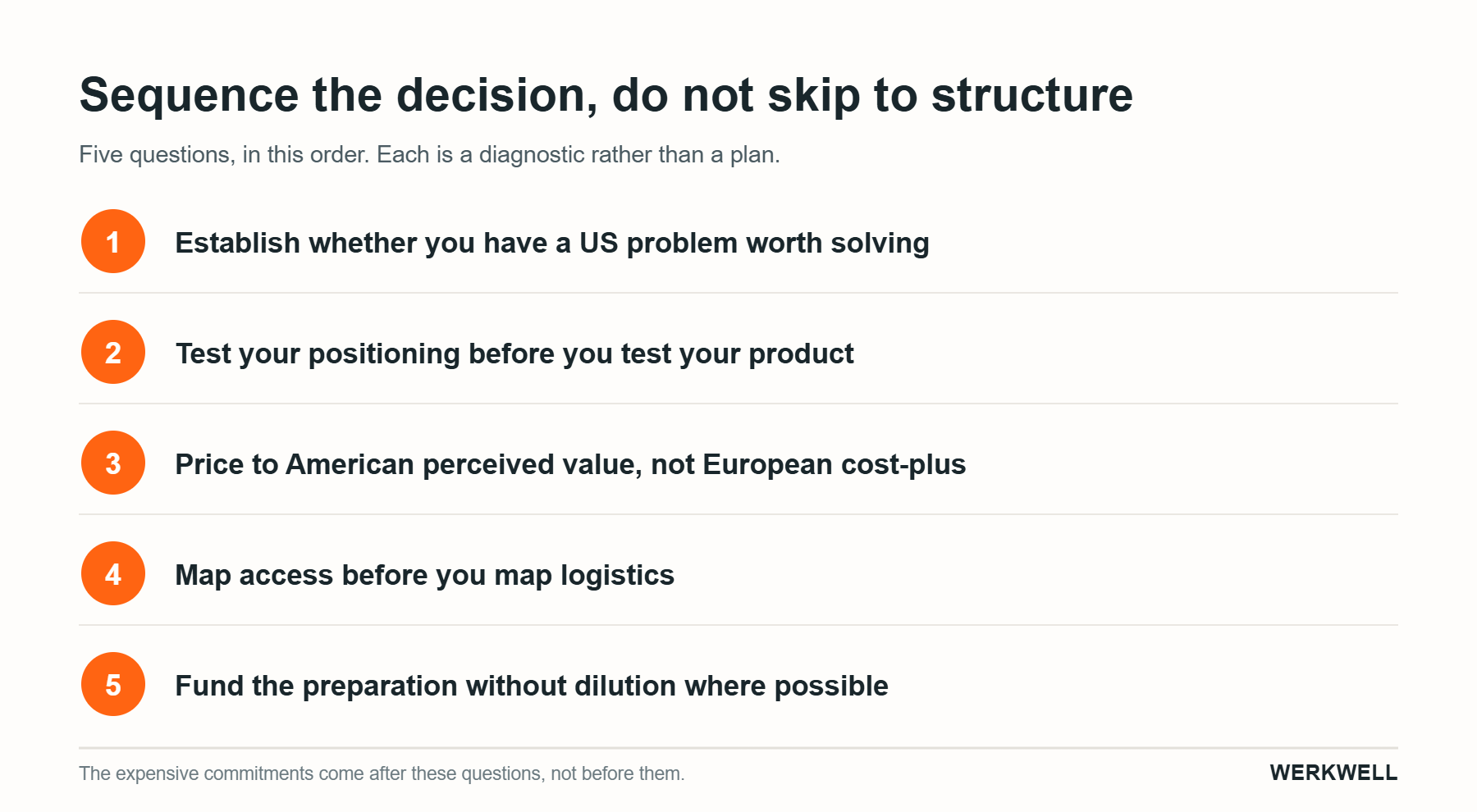
- Establish whether you have a US problem worth solving. Name the segment, the buyer, and what that buyer does today instead of buying from you. If you cannot do this in one paragraph and with comprehension, you are not ready.
- Test your positioning before you test your product. American buyers expect clarity, speed and a direct value statement. European materials tend to lead with technical depth and modesty, missing the point Americans seek in the first few minutes of meeting.
- Price to American perceived value, not European cost-plus. European pricing instinct systematically undersells in the US, and a low price is read as low confidence, or worse low value, rather than product or service performance and output.
- Map access before you map logistics. Office space, entity and hiring are the visible costs and the wrong first move. Relationships, warm introductions, and the right early partners determine whether investment in the rest will pay off.
- Fund the preparation without dilution where possible. Grant and subsidy routes for market preparation are widely available and underutilized, particularly in the Netherlands and across EU innovation programs. Dutch SMEs registered with the Chamber of Commerce may be eligible for 50% reimbursement of eligible costs through the RVO Support International Business scheme, subject to RVO approval. Significant non-dilutive and low-interest funding programs exist on both sides of the ocean to drive innovation and progress; the constraint is knowing how to access them.
Frequently asked questions about US market entry for European companies
Why is the EU Single Market described as fragmented?
Because divergent national standards, certification regimes, professional qualification rules and administrative requirements make cross-border trade materially more expensive than domestic trade.
How much does US market entry for European companies cost?
The cost of US market entry for European companies varies too widely to quote a meaningful figure, and the more useful question is how much you spend before validation. The recurring pattern is companies committing to office space, travel, legal work and hiring before establishing whether their proposition lands with an American buyer.
When should a European company start preparing for US entry?
If the US is on your roadmap in the next three to twenty-four months, preparation should start now. Positioning, pricing and buyer research take months and cost comparatively little; the expensive commitments should come after them, not before.
Can Dutch companies get funding support for US market preparation?
Dutch SMEs registered with the Chamber of Commerce are eligible for 50% reimbursement of eligible export training and coaching costs through the RVO Support International Business (SIB) scheme, subject to RVO approval. Sole proprietorships and partnerships are excluded.
Do we need a US entity before we can start selling?
Not necessarily and treating entity formation as step one is a common and expensive sequencing error. Commercial validation should generally precede legal structure. Specific requirements depend on your sector, contract type, and customer.
Where WerkWell fits in
WerkWell provides systems-based venture building for European companies entering the United States, based on decades of cross-border transaction experience and successful exits. We are not consultants: we are co-executors, treating readiness, positioning, buyers, capital, and team as one connected system rather than six separate projects. The objective is that you spend less on the right things, because the unknowns were removed.
Our Executive Masterclass is a working day in the Netherlands for European founders with a proven solution and America on the roadmap. You leave with your own US roadmap, built by you in the room, an honest list of your gaps, and a scheduled 1:1 session to discuss your case independently.
Learn more about the 2026 Executive Masterclass.
This article is for informational purposes only and does not constitute legal, financial, tax or regulatory advice.